
- Your cart is empty
- Continue Shopping

Info Articles
Inverters for Emergency Vehicles: How to Size an Inverter for an Ambulance or Patrol Car
-
By James Green
- Posted on
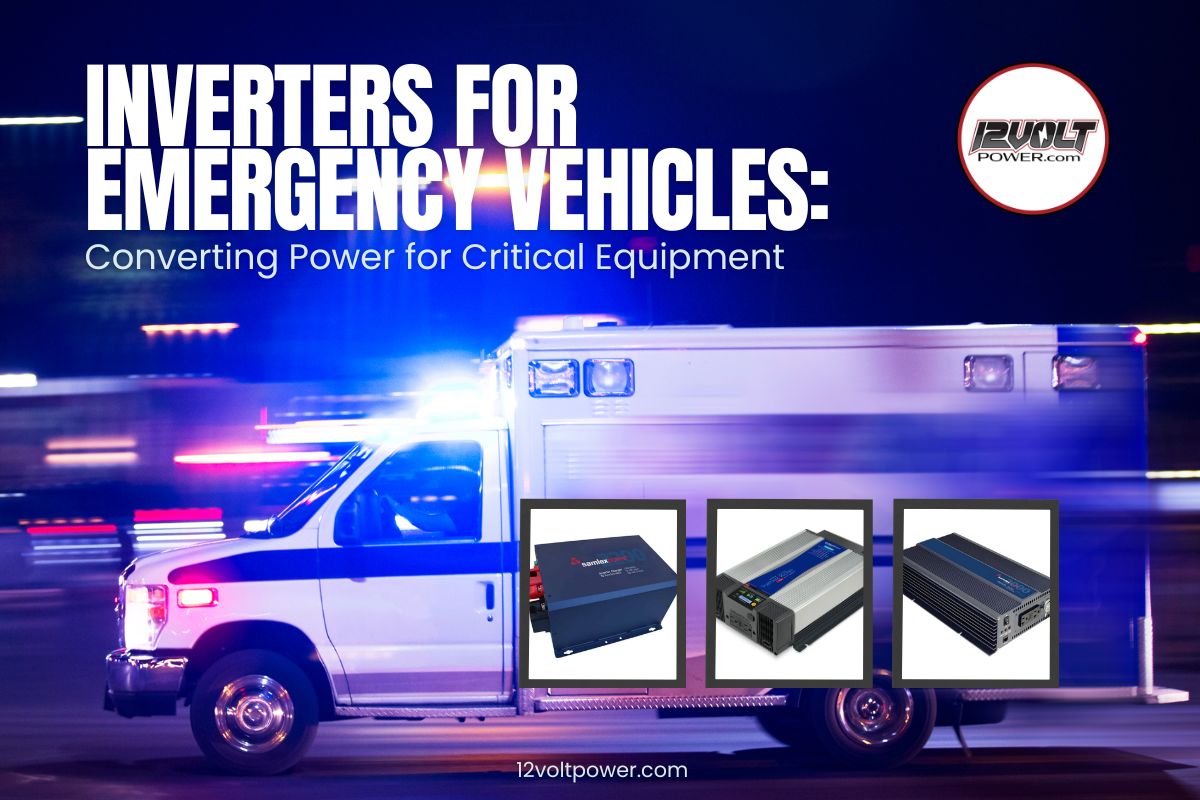
In the high-stakes world of emergency services, reliable power is essential. Emergency vehicles like ambulances and patrol cars depend on advanced electrical systems to keep critical equipment operational, from medical devices to communication systems. Inverters play a vital role in these setups, converting DC power from the vehicle’s battery into AC power required to operate essential devices.
This guide explains how inverters work, how to size them from the actual AC load, and how to evaluate current 12V pure sine inverter and inverter/charger options for emergency-vehicle installations.
What Is an Inverter and Why Is It Important?
An inverter is a device that converts direct current (DC) power from a vehicle’s battery into alternating current (AC) power, which is commonly used to power electronic devices and equipment. In emergency vehicles, where both AC and DC power are needed, inverters are critical for:
- Powering Medical Equipment: Devices such as defibrillators, ventilators, and monitoring systems in ambulances require AC power to operate effectively.
- Running Onboard Computers and Communication Systems: Patrol cars and ambulances often rely on laptops, printers, and other AC-powered equipment for seamless operations.
- Supporting Auxiliary Devices: Lights, charging stations, and refrigeration units are examples of additional devices that can be powered via inverters.
By converting energy from the vehicle’s DC electrical system for compatible AC loads, an inverter can support onboard equipment when it is correctly sized and integrated.
Key Features to Look for in an Inverter for Emergency Vehicles
- High Power Output
Emergency vehicles may operate several AC loads simultaneously. Size the inverter for the combined continuous load, startup surge, duty cycle, and expected future expansion. - Durability and Reliability
Inverters for emergency vehicles must withstand constant vibrations, heat, and heavy usage. Rugged designs ensure consistent performance in demanding environments. - Compact Design
Space is often limited in emergency vehicles. Compact, easy-to-install inverters maximize efficiency without taking up valuable room. - Compatibility With the Vehicle DC Electrical System
Verify DC input voltage, grounding, wiring, protective devices, alternator reserve, battery capacity, transfer requirements, and equipment-manufacturer guidance.
Inverter Applications in Emergency Vehicles
Inverters for Ambulances
Ambulances rely on inverters to power critical life-saving equipment.
- Sizing Approach: Select a current pure sine inverter only after calculating the continuous and startup loads of the approved onboard equipment.
- Application Note: Pure sine output may be appropriate for sensitive electronics, but it does not by itself establish suitability for medical or life-safety equipment. Verify each device manufacturer’s input, grounding, leakage-current, transfer-time, and power-quality requirements.
Key benefits include:
- Power Continuity: Confirm the inverter’s transfer behavior and the equipment’s allowable interruption time; do not assume zero interruption.
- System Validation: Have the complete installation reviewed by the vehicle upfitter or a qualified electrical-system designer.
Inverters for Patrol Cars
Patrol cars utilize inverters to power technology essential for law enforcement tasks.
- Sizing Approach: Match inverter output to the patrol vehicle’s verified simultaneous AC load and startup surge.
- Application Note: Current pure sine inverter options are available in multiple output ratings; select capacity only after verifying that the vehicle DC system can support it.
Key applications include:
- Powering Laptops and Mobile Data Terminals: Essential for field officers to access real-time information.
- Running Communication Systems: Provides stable AC power for radios, modems, and GPS units.
- Operating Auxiliary Equipment: Dash cameras, printers, and portable lighting systems can be powered effortlessly.
How to Choose the Right Inverter for Your Emergency Vehicle
When selecting an inverter for an ambulance or patrol car, consider the following:
- Power Capacity: Ensure the inverter can handle the combined load of all devices you intend to power.
- Durability: Look for rugged inverters designed to withstand harsh conditions.
- Compatibility: Ensure the inverter works with your vehicle’s DC electrical system and other electrical components.
- Additional Features: Options like integrated chargers or remote monitoring can add convenience and flexibility.
Two current options, and when each is right
Standalone pure sine: REDARC RS3 series
12 V in, 120 V pure sine out, integrated automatic transfer switch, vibration-resistant construction, 2-year warranty. Available in 1200 W, 2000 W and 3000 W — pick from your Step 3 number.
Choose it when the vehicle already has its charging sorted and you need clean AC plus automatic shore-power transfer. Operating range runs to 140°F with derating above 106°F, which matters in a closed module in July — mount it where air moves, not behind a cabinet panel.
Inverter/charger: Victron MultiPlus 12/2000/80-50 120V (UL 458)
Pure sine inversion, adaptive battery charging and a 50 A transfer switch in one enclosure, UL 458 listed, transfer under 20 ms, with PowerControl and PowerAssist.
Choose it when the vehicle plugs into shore power at station and you need the batteries properly charged between runs. Two reasons this beats a separate inverter and charger: one enclosure and one set of DC terminations instead of two, and an adaptive charge profile matched to your chemistry — which is what actually gets a bank to full state of charge, the failure this whole article started with. Confirm the charge profile suits your batteries; a lead-acid profile on lithium, or vice versa, undoes the benefit.
Victron’s reputation in this category is earned. We don’t have problems with them.
Benefits of Using Inverters in Emergency Vehicles
- Power Versatility: Inverters enable the use of both AC and DC devices, expanding the range of equipment emergency vehicles can support.
- System Reliability: A properly engineered inverter system can support approved AC loads, but reliability depends on sizing, wiring, protection, thermal management, and equipment compatibility.
- Cost-Effectiveness: A single inverter can power multiple devices, eliminating the need for specialized equipment and reducing costs.
- System Integration: Match input voltage, DC cabling, overcurrent protection, grounding, ventilation, and transfer behavior to the vehicle and connected equipment.
Conclusion
Inverters can support approved AC equipment in emergency vehicles when the complete system is properly sized and validated. Current options include REDARC RS3 standalone pure sine inverters and the Victron Energy MultiPlus inverter/charger for systems that also require integrated charging and transfer functions.
At 12 Volt Power, we specialize in top-quality inverters and 12V battery and charging systems tailored for emergency vehicles. Explore our range of products to find the perfect solution for your power needs, and keep your fleet powered and prepared for any situation.
Give us a call at (657) 295-6315 or reach out through 12voltpower.com.